
Megapolis
v14.3.0

Download APK Safe - Fast - Free!
Establish the ultimate retail empire with the latest Idle Supermarket Tycoon apk, available for secure and high-speed installation via GB Plus Apps. Developed by Codigames, this definitive incremental management simulator challenges players to master Incremental Inflation by balancing critical Cashier bottlenecks with departmental upgrades. Utilize the strategic Prestige system to unlock high-yield locations like Miami Beach and maximize your City Multipliers to sustain exponential growth. Download now to optimize your profit logic and dominate the tycoon leaderboards.




Idle Supermarket Tycoon stands as a foundational pillar within the mobile incremental management genre, distinguished by its vertical-slice simulation design. Developed and published by the Valencia-based studio Codigames, the title operates on a sophisticated engagement engine that prioritizes logarithmic capital growth over the complex mechanical interactions found in PC simulators. The application utilizes a shared Unity-based code architecture, similar to the studio's other hits like Prison Empire Tycoon, to deliver a polished "Retail" vertical experience.
The technical identity of the Idle Supermarket Tycoon apk is defined by its ability to minimize cognitive load while maximizing the dopamine response associated with numerical progression. Unlike sandbox games where player agency dictates the floor plan, this title relies on a rigid mathematical progression system known as "Incremental Inflation." The core appeal lies in optimizing throughput and eliminating bottlenecks across a pre-designated layout. Whether managing a small grocery store or a massive shopping mall, the objective remains the same: automate revenue generation to facilitate rapid expansion into new economic territories.
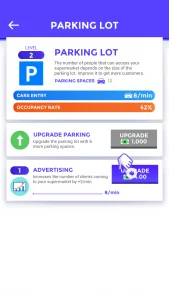
The primary gameplay loop is governed by the Theory of Constraints, forcing players to balance three critical nodes: Inflow (Parking Capacity), Processing (Department Service Speed), and Outflow (Cashier Speed). If the Cashier throughput is lower than the department output, customers abandon their carts, resulting in lost revenue. This forces a strategic balancing act where upgrades must be distributed evenly rather than focused solely on product value.
Idle Supermarket Tycoon features a strictly linear progression of departmental unlocks, each serving a specific role in the economic hierarchy:
While the game is accessible as a Idle Supermarket Tycoon free to play experience, it employs aggressive exponential cost scaling ($Cost_n = Cost_{n-1} times 1.07$). This often creates "retention trenches"—specifically between the Small Village and Small City stages—where progress stagnates to encourage the use of ad-based multipliers or premium management features.
Codigames utilizes a vibrant, low-poly 3D aesthetic designed to minimize GPU overhead, ensuring the application runs smoothly across a wide range of devices. The visual evolution of the game has been a point of community discussion, particularly following the version 3.0 update which overhauled the art style. The game transitions from simple "blobby" characters to more detailed models, aligning the visual identity with the broader "Empire Tycoon" portfolio.
The atmosphere is heavily influenced by the "City Progression" system, which acts as the game's prestige mechanic. As players accumulate wealth, they sell their operation to move to more affluent locations, resetting their infrastructure in exchange for permanent global multipliers. Visual backdrops change drastically during this progression:
This progression is supported by humorous product descriptions that evolve with the department levels. A Produce item might start as "Overripe Fruit" and evolve into "Martian Fruit" or the recursive "Banana Badoo," reinforcing the game's shift from terrestrial economics to absurd, galactic scaling.
The meta-strategy revolves around managing the "Prestige" timing. Players often hesitate to reset their progress, but the math dictates that moving cities is mandatory for long-term growth. The primary retention hook is the "Stars" system and the granular upgrading of product lines. Since the cost to unlock departments increases by orders of magnitude, players must rely on Epic Upgrades (permanent modifiers) purchased with Gems to sustain momentum.
To handle the astronomical numbers inherent to the genre, Idle Supermarket Tycoon uses a specific alphabetical notation system (q, Q, s, S, d, D) once values exceed standard trillions. This creates a unique learning curve where players must distinguish between a "Quadrillion" ($10^{15}$) and a "Quintillion" ($10^{18}$).
Strategic Optimization:
The in-game economy is built on a dual-currency system: Cash (Soft Currency) for temporary upgrades and Gems (Hard Currency) for permanent boosts. The monetization model is a hybrid of "Freemium" mechanics, utilizing Rewarded Video Ads (RVAs) to alleviate inventory throughput pain points. A critical component of the economy is the General Manager IAP, which automates cash collection and extends the idle time cap, addressing the frustration of lost income during offline periods.
Due to the aggressive scaling of costs in the late game, specifically around the Beverly Hills to Paris transition, some users actively search for a Idle Supermarket Tycoon mod. These modified APKs often attempt to inject unlimited money or freeze currency values. However, Codigames employs robust server-side validation for Hard Currency and premium assets like Epic Upgrades. Consequently, while client-side mods may visually display infinite gems, they often fail to execute server-verified transactions and disable Cloud Save functionality, isolating the player from events.
For a secure experience that guarantees access to LiveOps events (like the Halloween or Franchise modes) and cloud backups via Google Play Games, players are strongly advised to stick to the official Idle Supermarket Tycoon download. Legitimate progression ensures that the sophisticated "City Multiplier" logic functions correctly, preventing the game from breaking due to mathematical overflows common in unauthorized versions.
At its heart, Idle Supermarket Tycoon operates on a vertical-slice simulation model governed by the "Theory of Constraints." Unlike complex PC simulators where you manually stock shelves, this game automates the physical labor, leaving you to manage the mathematical bottlenecks of a growing retail empire. The primary objective is to maximize revenue per minute to fund exponential growth costs.
The control scheme is strictly touch-based. You do not control a character avatar; instead, you act as the omnipotent manager. The gameplay loop follows a specific Subject-Predicate-Object logic:
For players initiating their first Idle Supermarket Tycoon download, the most critical control is the Statistics Button (usually a chart icon). This reveals your current "idle cash" accumulation rate, allowing you to identify which node (Parking, Department, or Cashier) is currently throttling your profits.
While the game presents itself as a continuous simulation, it is structured around a "Prestige" mechanic known as City Progression. Understanding this macro-loop is essential for long-term success.
In the standard gameplay mode, your goal is to unlock departments in a linear order. You begin with low-margin sections like the Produce Department and progress toward high-ticket luxury zones.
Once you earn enough cash, you are encouraged to sell your supermarket and move to a new city. This is the core "Prestige" mode. Moving resets your cash, employees, and building levels to zero, but grants a massive global multiplier to your income.
For example, moving from a Residential Area (x1 Multiplier) to a Small Village grants a x50 Multiplier. Progression continues through locations like Miami Beach (x100), Paris (x250), and eventually into sci-fi territories like The Moon (x1,000) and Mars. If you are playing on a standard Idle Supermarket Tycoon apk, this reset is the only way to overcome the exponential inflation of upgrade costs.
Progression is fueled by a dual-currency economy: Cash (Soft Currency) and Gems (Hard Currency). Managing these resources is vital, especially for a Idle Supermarket Tycoon free player who does not wish to spend real money.
One unique aspect of the progression is the "Large Number Notation." Once you surpass Trillions, the game uses an alphabetical system (q, Q, s, S). Be careful not to confuse "q" (Quadrillion, $10^{15}$) with "Q" (Quintillion, $10^{18}$), as mistaking these values can lead to poor spending decisions.
| Currency / Resource | How to Earn | Best Strategic Use |
|---|---|---|
| Cash (Soft Currency) | Generated by selling products. Automated via the General Manager. | Re-invest immediately into the cheapest available upgrade (Parking, Cashier, or Product Level) to maintain compound growth. |
| Gems (Hard Currency) | Completing Missions, watching Rewarded Video Ads, or IAP. | Epic Upgrades. Prioritize permanent boosts like "x2 Profit" or "Compounding Profits." Do not waste on Time Warps. |
| Manager Cards | Opening chests (introduced in v3.0 updates). | Equip Legendary Managers to high-earning departments (like Electronics or Real Estate) to maximize passive income. |
The current "Meta" revolves around manipulating the bottleneck to suit the specific department you are currently focused on.
In the early cities (up to Small City), your strategy should be Volume-Centric. You must aggressively upgrade Cashiers because the Produce Department floods the checkout zone with low-cost items. If you ignore cashiers here, you lose 50%+ of your potential income to abandoned carts.
However, once you unlock the Car Dealership or Real Estate Agency, the Meta shifts to Value-Centric. These departments serve very few customers (sometimes only one every few hours). In this phase, cashier speed is irrelevant. You must pour all resources into the Department Level to ensure that the single transaction that occurs yields Quadrillions (q) or Quintillions (Q) of cash.
Players often search for a Idle Supermarket Tycoon mod to bypass the grind. It is crucial to understand that while client-side mods might freeze your Cash values, the game uses server-side validation for Gems and Epic Upgrades. The "Prestige" multipliers and City unlocks are often verified against the cloud save. Therefore, visual glitches in modified versions often result in a "sync error" when attempting to purchase valid server-side assets like the General Manager or moving to Hong Kong.
To maximize your retail empire efficiency without hitting a paywall, follow these actionable tips: